What do people know about Sustainbility?
I recently distributed a Google form to students at my high school in order to gain a better understanding of what they know and don’t know about sustainability. These statistics are modest, but they could certainly be improved by educating students about environmental sustainability at an earlier age.
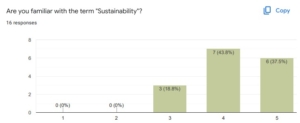
My first question was simple and it asked: “Are you familiar with the term Sustainability?” It was rated on a scale of 1 to 5, with 1 meaning you have no idea, and 5 meaning you do. 43.8 % knew what the phrase “sustainable” meant but COULDN’T define the term correctly. 37.6% said they knew what the word meant and COULD explain it accurately. While 18.8 % were in the middle, knowing what sustainability was but unable to define it.
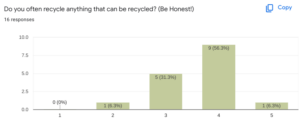
My second question was direct and asked: “Do you often recycle anything that can be recycled? (Be Honest!)” It was rated on a scale of 1 to 5, with 1 indicating that you don’t recycle and 5 indicating that you do. 56.3% responded with a 4/5, indicating that they recycle frequently but not always. 31.3 % replied 50/50, which indicates they recycle only half the time. Finally, one individual stated that they rarely recycle, whilst another stated that they regularly recycle.
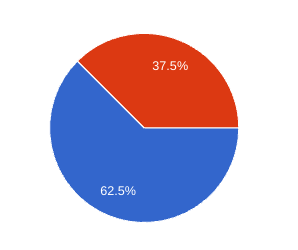
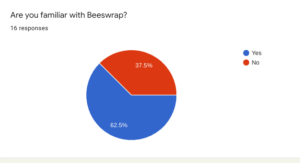
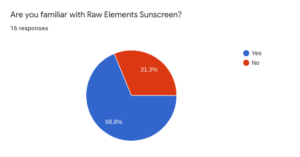
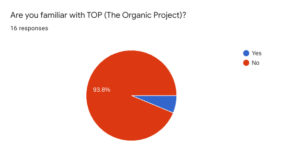
My third question focused on the three products I researched and how familiar they were with each. 62.5 % knew what Bees Wrap was, while 37.5 % didn’t. Raw Elements sunscreen was known by 68.8% of respondents, while 31.3 % were not. Finally, just 6.3 % of students knew what TOP was, while the majority (93.8 %) did not.
Finally, these results revealed that when it came to questions concerning sustainability and recycling, the majority of students fell somewhere in the center. Although this is better than nothing, I believe it is critical to raise the 3/5 knowledge level to a 5/5 level so that people are fully aware of what they are doing and how it impacts our environment. Understanding sustainability and all it entails is essential because it is the path to a brighter future for not just our environment but also our lives.
When it came to questions concerning Bees Wrap, Raw Elements, and TOP, I was surprised to learn that more than half of the respondents had an idea of what they were talking about. Given that TOP is a menstrual product and some of the respondents were guys, I expected a large number of students to be unaware of it. Since more than 3/4 of the respondents were unaware of TOP, my assumption was true.
Finally, the distribution of the google form and the replies provided me and others with a greater grasp of what the vast majority of students know and don’t know. This is crucial because, based on what we already know, understanding the knowledge of individuals around us can help people like teachers enhance their knowledge of students on matters like sustainability.


